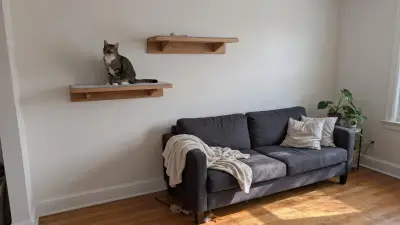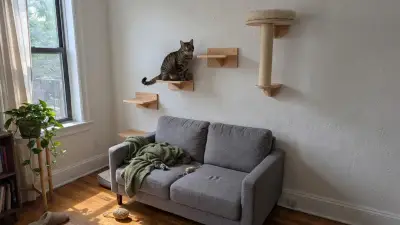
Narrow hallways and tight apartment corners rarely leave floor space for traditional cat furniture, yet unused vertical angles can hold a complete feline climbing route without blocking your walkway. By mounting slim corner shelves, vertical sisal posts, and tucked-in perches above shoulder height, you give your cat safe vertical territory while keeping doors and walkways completely clear.
Indoor cats rely on elevated vantage points to feel secure and burn energy, especially in compact homes where flat walls are already occupied by artwork, doorways, or windows. Choosing corner-hugging designs with low wall projection protects your hips and shoulders as you walk past while offering sturdy grip and predictable jump spacing for cats of different ages and sizes.
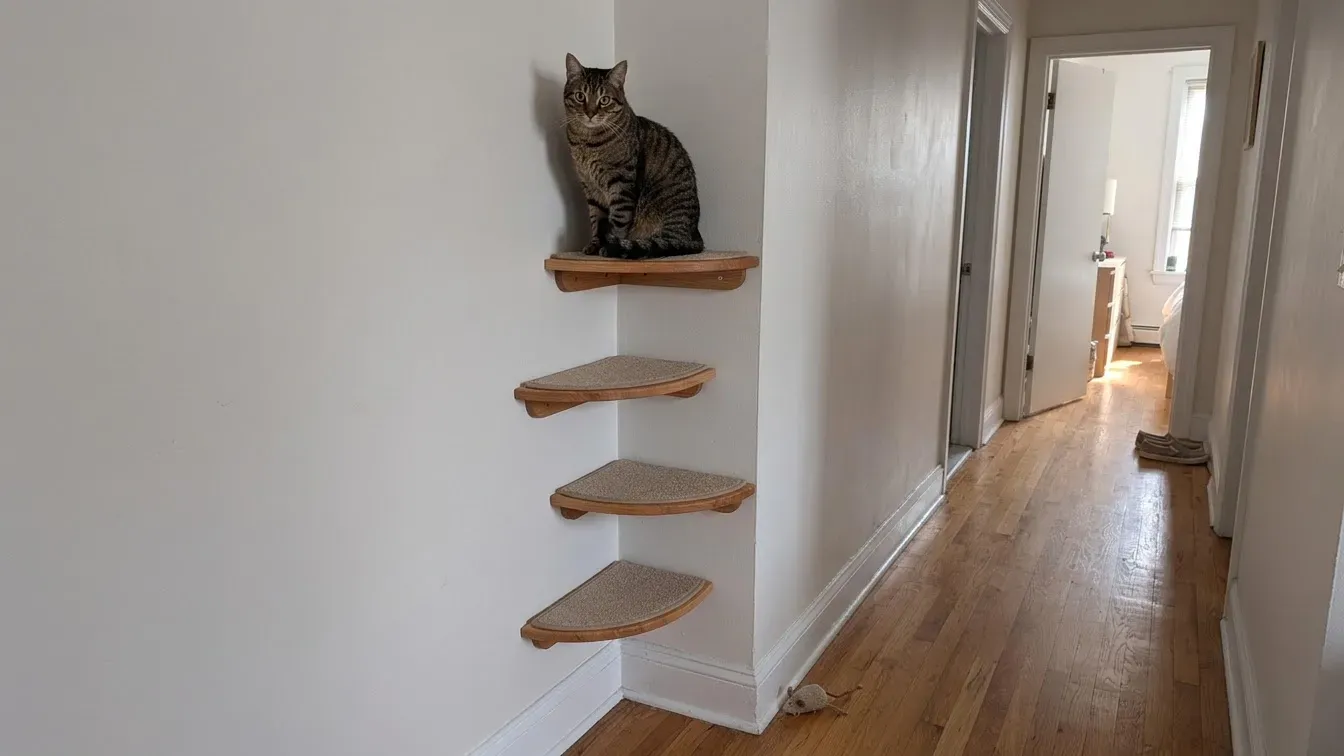
1Quarter-Circle Floating Corner Step Ladder
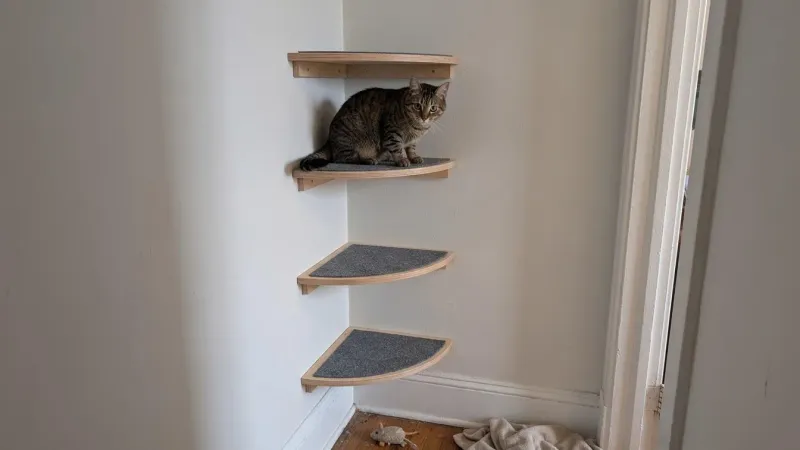
Quarter-circle wooden shelves tuck neatly into 90-degree wall joints while protruding less than 11 inches (28 cm) into the hallway. Stagger four to five compact pie-shaped platforms every 14 inches (35 cm) vertically in an alternating left-right pattern. Cover each top surface with low-pile carpet tiles so your cat gets firm claw traction when pivoting sharply in tight quarters.
2Wall-Anchored Floor-to-Ceiling Corner Sisal Column
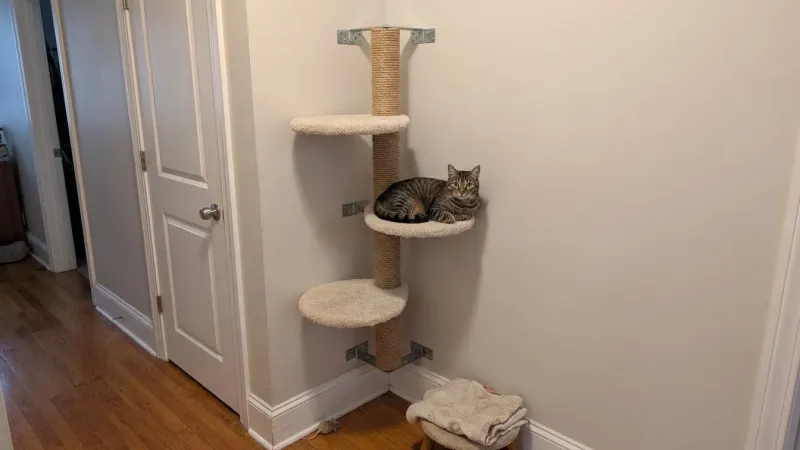
An adjustable corner post spanning 92 to 102 inches (234 to 259 cm) between floor and ceiling must be secured directly into the corner wall studs with heavy-duty L-brackets so lateral leaps in a narrow hallway never tip the column. Wrapped in thick natural sisal rope with three compact 10-inch (25 cm) round perches, it occupies a tiny 12-inch (30 cm) corner footprint. Check the wall brackets and tighten the top tension rod monthly so vigorous climbing never loosens the brace.
3Over-the-Doorway Corner Bridge and Perch
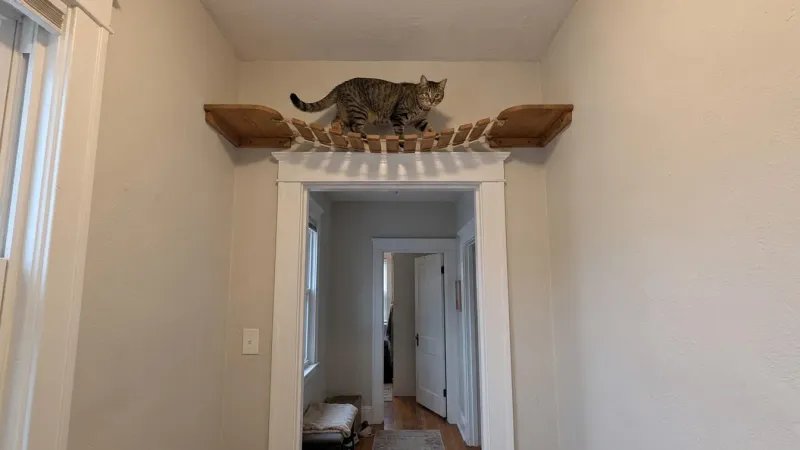
Turn the dead space above a hallway doorframe into a high-altitude lookout by flanking the corner with two compact corner shelves at 76 inches (193 cm) high. Connect them with a 9-inch (23 cm) wide rope-and-slat bridge running safely above standard human head height. This keeps the entire floor corridor open while giving indoor cats an uninterrupted patrol route.
4Slim Corner Scratching Post With Top Lookout
Mount a 48-inch (122 cm) vertical sisal-wrapped corner column starting 24 inches (61 cm) off the baseboards so vacuum cleaners pass cleanly underneath. Top the post with a triangular padded lounging platform tucked snugly into the corner angle. Cats can stretch full-length vertically while scratching and pull themselves straight onto the elevated bed.
5Staggered Triangular Shelf Spiral
Right-triangle shelves mounted flush along alternating corner walls create a tight upward spiral without sharp protruding corners that snag clothing. Space five 12-inch (30 cm) triangles at 13-inch (33 cm) vertical steps, starting above hip height. This geometry works especially well in narrow studio corridors, complementing other wall mounted cat trees for small studio apartments.
6Tucked-In Corner Canvas Hammock Tower
Pair two rigid corner entry steps with a triangular heavy-duty cotton canvas hammock anchored across both adjacent corner walls. Because fabric cradles your cat's body weight inward toward the wall joint, it needs only 13 inches (33 cm) of outward projection. Choose machine-washable canvas sleeves so you can easily remove shed fur and dander.
7Four-Level Solid Wood Corner Climbing Kit
A prefabricated 73-inch (185 cm) multi-level corner tower kit combines vertical support rails with four pre-drilled triangular steps and a plush top hammock. Because the rails bolt directly into both corner walls, weight distributes evenly across multiple studs. Its narrow 14-inch (35 cm) profile hugs hallway corners tightly while supporting active adult cats.
8High-Wall Corner Condo Cubby
Shy cats in busy households appreciate an enclosed corner hideaway mounted 68 inches (173 cm) above the hallway floor. A pentagon-shaped wooden box fits flush into the 90-degree angle with a front circular entry hole and a flat carpeted roof perch. Cats can nap undisturbed above passing footsteps while peeking out through the doorway.
9Angled Corner Ramp With Sisal Grip
Senior cats, kittens, or short-legged breeds often struggle with vertical leaps in narrow corridors. Mount two 30-inch (76 cm) angled wooden ramps covered in ribbed sisal carpeting along adjacent corner walls, joined by a small square landing platform in the corner vertex. The gentle 35-degree incline lets cats walk up effortlessly without steep jumping.
10Dual-Wall L-Shaped Lounge Shelf
Join two 11 to 12-inch (28 to 30 cm) deep planks at a right angle inside a hallway corner to form an L-shaped wrap-around perch. Wrapping the bed around the corner gives cats 24 inches (61 cm) of total lounging length on each wing with enough depth to lie down and turn around safely while still keeping projection compact. Add a removable bolster cushion secured with hook-and-loop strips.
11Recessed Corner Nook Ladder
Many hallways have an awkward 14-inch (35 cm) bump-out near closets or utility shafts. Install three 11-inch (28 cm) wide floating steps inside that recessed pocket to create a completely flush climbing column. Because the shelves sit inside the wall recess, nothing projects past the main hallway plane at all.
12Curved Acrylic Bowl Corner Perch
Mount a corner-bracketed wooden frame holding a clear acrylic bubble bowl 70 inches (178 cm) up in a bright hallway corner. The curved basin lets your cat curl up securely without needing wide flat ledges, while the clear bottom lets hallway ceiling light pass through so the corner never feels dark or heavy.
13Solid Wood French Cleat Corner Modular System
Fasten two narrow 16-inch (40 cm) wide solid hardwood French cleat or slotted rail panels side-by-side into corner wall studs using hardware rated for dynamic pet loads. Lock movable corner shelves and small sisal rollers onto the cleats so you can adjust step spacing as a kitten grows into an adult while keeping food and water bowls safely on the floor away from climbing paths. Always verify that locking pins are fully seated before letting your cat climb.
14Low-Heat Hydronic Baseboard Corner Perch
Never mount cat perches directly over active steam or high-heat radiators, which expose cats to burn risks and excessive heat buildup. In hallways with low-temperature covered hydronic baseboards, mount a solid wood corner shelf with a heat-shielded underside at least 12 inches (30 cm) above the cover, then build three climbing steps upward from there while avoiding open flames or space heaters.
15Slim Geometric Honeycomb Corner Cluster
Interlock three hexagonal wooden cubbies into a vertical corner stack, alternating open pass-through frames with closed-back napping boxes. Each hexagon projects just 11 inches (28 cm) from the wall corner while offering internal climbing holes so cats ascend through the center rather than leaping outward into the hallway.
16Twin-Wing Multi-Cat Corner Passing Station
When two cats share a narrow hallway tree, single-file ladders can spark territorial blocking. Install a central corner landing platform flanked by two separate exit shelves—one leading left toward a bedroom doorway and one leading right toward a living room—modeled on modern cat trees for multiple cats with separate high perches.
How to Measure and Mount Corner Cat Furniture Safely
Before drilling into a hallway corner, measure both wall depth and headroom so human traffic flows freely. Keep lower steps at least 64 inches (163 cm) above the floor in busy corridors—pairing that high entry point with lower stepping platforms in an adjacent room, dead-end alcove, or over a sturdy piece of furniture so your cat can actually reach the 64-inch level—or limit lower perches to dead-end corners where people do not walk past. Aim for a maximum projection of 10 to 12 inches (25 to 30 cm) from the corner point so shoulders and carried laundry baskets never clip the wood edges.
Always anchor brackets directly into corner wood studs rather than relying on hollow drywall anchors alone. Most residential interior corners feature framing studs right at the joint and 16 inches (40 cm) out along each adjoining wall. Use a magnetic stud finder to locate the framing, pre-drill pilot holes, and secure brackets with heavy-duty lag screws rated well above your cat's jumping weight—especially if you have a large breed like a Maine Coon or Ragdoll that lands with extra momentum.
Check door swing arcs and light switch clearance before marking your holes. Tape cardboard templates onto the corner walls and swing nearby bedroom or closet doors wide open to confirm zero contact. If you live in a home with young children, pair high corner installations with ideas from our guide on wall mounted cat trees that keep cats safe from toddlers so your cat always has a quiet retreat out of reach.
Common Mistakes to Avoid in Tight Hallways
The biggest mistake in narrow spaces is spacing shelves too far apart vertically or horizontally. While agile young cats can leap 24 inches (61 cm) straight up, senior cats, kittens, and heavy-bodied cats need shorter 12 to 16 inch (30 to 40 cm) intervals with overlapping corner angles so they never feel trapped at the top. Always provide a clear downward route or second exit branch so multi-cat households do not experience corner bottlenecks.
Avoid smooth, bare lacquered wood in narrow corridors where cats make tight 90-degree turns. Without carpeted treads, cork pads, or wrapped sisal surfaces, paws can slip during sharp pivots, increasing the risk of a fall onto hard hallway flooring. If your cat ever hesitates to jump, limps after landing, or shows sudden stiffness, consult your veterinarian to check for joint pain or mobility issues before adjusting shelf heights.
Turning a tight hallway corner into a vertical cat tree solves two everyday problems at once: your walkway stays completely clear, and your cat gains a safe, elevated vantage point away from busy floors. Measure your door swings carefully, anchor every bracket directly into corner wall studs, and keep step spacing under 16 inches (40 cm) so your cat can climb confidently for years.
Sources: International Cat Care · Cornell Feline Health Center
Frequently asked questions
How much space do corner wall mounted cat trees need in a narrow hallway?
Choose corner shelves that project no more than 10 to 12 inches (25 to 30 cm) from the wall joint, and mount the first hallway-level step at least 64 inches (163 cm) above the floor in high-traffic walkways so people can pass underneath without bumping shoulders—pairing it with a lower starting step 14 to 18 inches (36 to 46 cm) off the floor in an adjoining dead-end corner or low-traffic zone so your cat can climb up to that height.
How far apart should corner cat shelves be spaced vertically?
Space corner steps 12 to 16 inches (30 to 40 cm) apart vertically for most healthy adult cats. For kittens, senior cats, or large heavy breeds, keep gaps closer to 10 to 12 inches (25 to 30 cm) with overlapping angles for easy footing.
Can I mount a corner cat tree into drywall without hitting studs?
No, jumping cats generate dynamic force well beyond their resting body weight, which can pull toggle bolts out of plain drywall. Always anchor corner brackets directly into the wooden framing studs located at the wall corner and 16 inches (40 cm) out.
Are corner wall mounted cat trees safe for large cats?
Yes, provided the shelves are at least 12 inches (30 cm) deep, covered in non-slip carpet or sisal, and fastened into wood studs with heavy-duty lag screws rated for at least 40 to 50 pounds (18 to 23 kg) of dynamic load.

Nathan Brooks
Nathan Brooks runs Farmingzoom to help loving pet owners create safe, enriching homes for their animals. He cares deeply about responsible pet care and focuses on making everyday decisions simpler for fellow owners.…